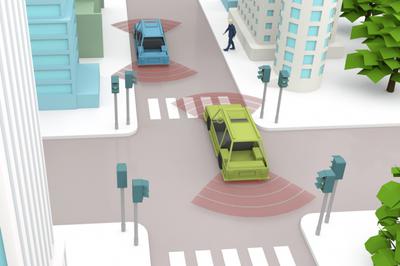
"Psychological roadblocks" for self-driving cars
Iyad Rahwan on the trust gap between people and autonomous vehicles.
Iyad Rahwan on the trust gap between people and autonomous vehicles.

Welcoming three LEGO Papert Fellows and six Learning Innovation Fellows to our new cohort
There’s no "silver-bullet technical solution" to the challenges in decentralizing the web.
In July 2016, Andrew "bunnie" Huang and Edward Snowden presented their research on journalist-friendly mobile surveillance resistance at the first MIT Media Lab Forbidden Research conference; a little over a year later, they have published an extensive scholarly paper laying out the problems of det…
Exploring the history of the Media Lab's name.
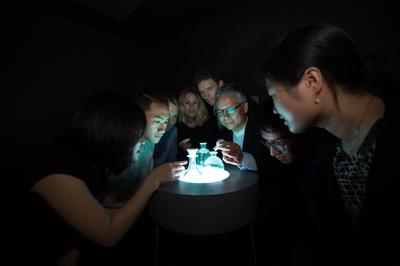
How ideas derived from art can lead to new technological concepts.
Director of the MIT Center for Civic Media Ethan Zuckerman talks about activism, technology and the future of the digital ecosystem.
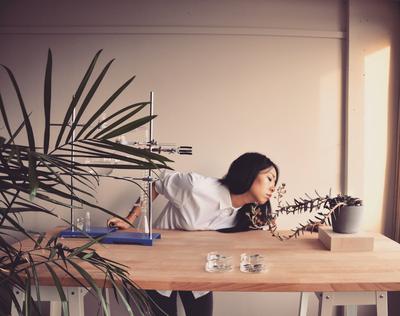
It’s along the way that you find all these weird moments when something else gets born.
The RFly system catalogues items instantly as the drones fly up and down aisles.
Eric Topol, editor-in-chief of Medscape, interviews Synthetic Neurobiology head Ed Boyden.
New documentary chronicles Jacob Collier's collaborations at MIT.
Author Todd Balf gets a front-row seat as Hugh Herr plots his next big act—a $100 million project to end a slate of disabling conditions
As the global spotlight falls on the ongoing refugee crisis in Syria and other Middle East regions, among its various impacts is the threat it poses to the future of millions of displaced students, who are at the risk of losing access to higher education. Taking up this unprecedented and urgent sit…
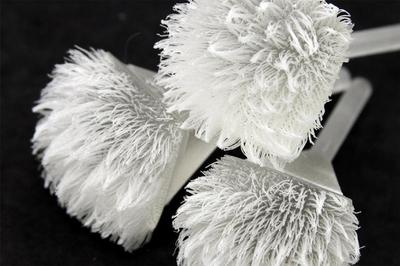
A fresh update from the Tangible Media Group is the latest attraction of the RADICAL ATOMS exhibition in the Ars Electronica Center
Jacob Collier calls from Chile, where he’s in the middle of a South American tour. He’s a long way from the London bedroom where he got his start, showing off his virtuosity and intricate arrangements in YouTube videos that caught the eye of no less a starmaker than Quincy Jones. A few short years …
In 2013, bioengineer Wen Wang, then a research scientist at MIT, attended a talk on how Bacillus spores shrink in response to falling relative humidity. The research, published the following year in Nature Nanotechnology (9:137-41), focused on using this property to extract energy, but it gave Wang…

How two years at the MIT Media Lab changed a student’s perspective of her art in the world
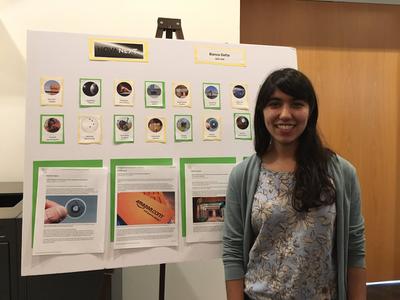
By Bianca DattaI spent this summer working with the digital team at NOVA, writing for the NOVA Next site. I worked directly with Senior Editor Tim DeChant, and occasionally with associate editor Allison Eck. I wrote 18 pieces about topics as varied as the impact of the internet of things, biologica…
What are the legal rights of a robot? This is one of the many questions MIT Media Lab researcher Kate Darling contemplates as part of her work in robot ethics.Robots have been working for decades in manufacturing, but now robots that focus on human interaction are becoming more common. Studies of h…
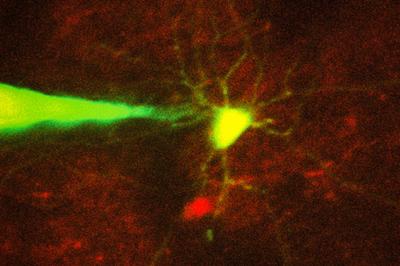
Success rate is comparable to that of highly trained scientists performing the process manually
Patch clamping, a method that allows scientists to study the electrical activity of single cells, is one of the oldest tools in the neuroscience toolbox. Although the technique was originally developed around the late 1970s to study neurons in a dish, over the last few decades, scientists have adap…
There are many mysteries of human biology. Among those perhaps least considered, what do our bodies sound like?This was the question on the mind of the founders of Biota Beats, a collective of biologists and biology enthusiasts making music that explores the sound of the human microbiome. David Kon…
Digital Trends on RFly: Drones that find missing objects using battery-free RFIDs.