Our extended sensoria
How humans will connect with the Internet of Things
How humans will connect with the Internet of Things
New “expansion pathology” technique lets optical microscopes go where only electrons could go before.
Artificial intelligence is outperforming the human sort in a growing range of fields—but how do we make sure it behaves morally?
Robots only want your love...and occasionally some anonymized metadata.
You’ll likely hear Hugh Herr before you see him.The charismatic leader of MIT’s biomechatronics research group wears two next-generation prosthetic legs, each barely visible under the cuff of his gray slacks, which produce a faint percussive buzz with each footfall, like the sound of a tiny electri…
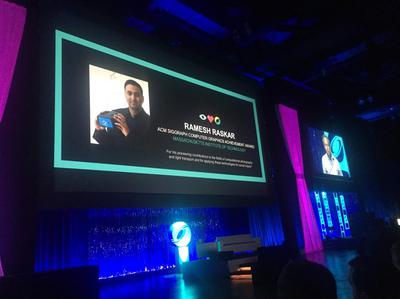
Ramesh Raskar receives award at ACM SIGGRAPH 2017Raskar, who directs the Camera Culture research group at the MIT Media Lab, is this year’s recipient of the Computer Graphics Achievement Award.When he accepted SIGGRAPH’s 2017 Computer Graphics Achievement Award, Ramesh Raskar said that he was “deli…
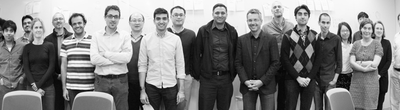
The point isn’t to create a new startup, the point is to create a culture of innovation.By Tobi AmosMIT Media Lab
News organizations these days are spending a lot of time and energy making sure that data plays a central role in their newsrooms. But fewer are putting as much effort into building that kind of data culture into their organizations overall.That argument is core to the Data Culture Project, a new e…
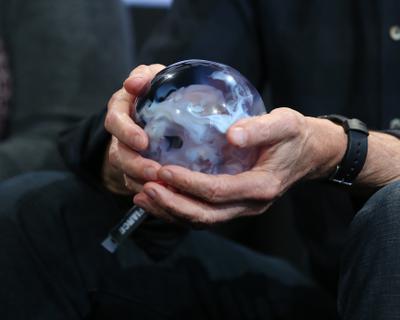
MIT Media Lab summer event explored responsible dissent, embodied in its new Disobedience Award.
Digital single market conference on the free movement of data (see Professor Alex "Sandy" Pentland from minute 36)The priorities of the Estonian Presidency are actively focused on creating a digital single market within the EU. The digital single market cannot be built without a special emphasis on…
MIT initiative is producing climate recipes for tastier crops.

Mona Hanna-Attisha and Marc Edwards win 2017 Disobedience Award
A new type of leadership development for the social sector.
Congratulations to winners Dr. Mona Hanna-Attisha and Professor Marc Edwards
Our winners reflect the hopes that led to the award in the first place. Drs Hanna-Attisha and Edwards are scientists who became activists
The pediatrician and professor who first drew national attention to the water crisis in Flint received the first Disobedience Award.
If we want socially assistive robots instead of robot overlords, well, that’s on us.

Images from the 2017 Defiance event and Disobedience Award

Pursue modular "daisy drive" platforms with the potential to safely, efficiently, and reversibly edit local sub-populations of organisms
Bettina Arkhurst comes from a large, tight-knit family. Her relatives hail from across the U.S., Canada, Europe, Australia, and Ghana. They fly to celebrate birthdays, graduations, and family reunions, and support one another during difficult times. Coming to MIT, Arkhurst quickly settled in and ma…
Far too many movies portray taking the law into your own hands a solution for change.
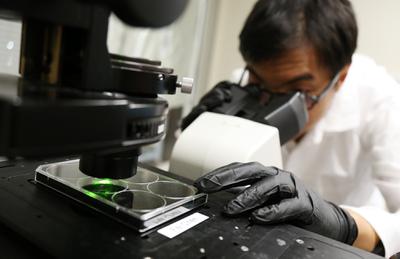
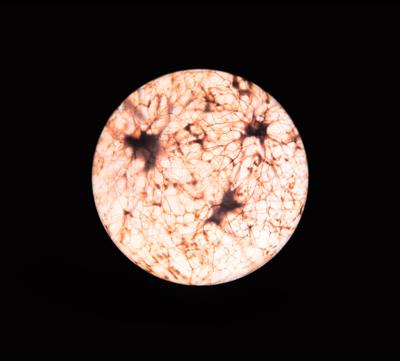
Enlarging clinical samples for imaging to understand the building blocks of pathologies with nanoscale precision
Hugh Herr tells the BBC that we're entering a new era of human-machine interoperability
Facebook volunteers and work-at-home moms might be making city planning decisions, thanks to AI research conducted by MIT scientists. Researchers from MIT’s media lab have been feeding computers a steady stream of data for the last four years to build an AI capable of determining why some cities gr…